Alexander Rabe, Managing Director of eco Association: “Cookie banners are impractical for both users and website providers alike.”
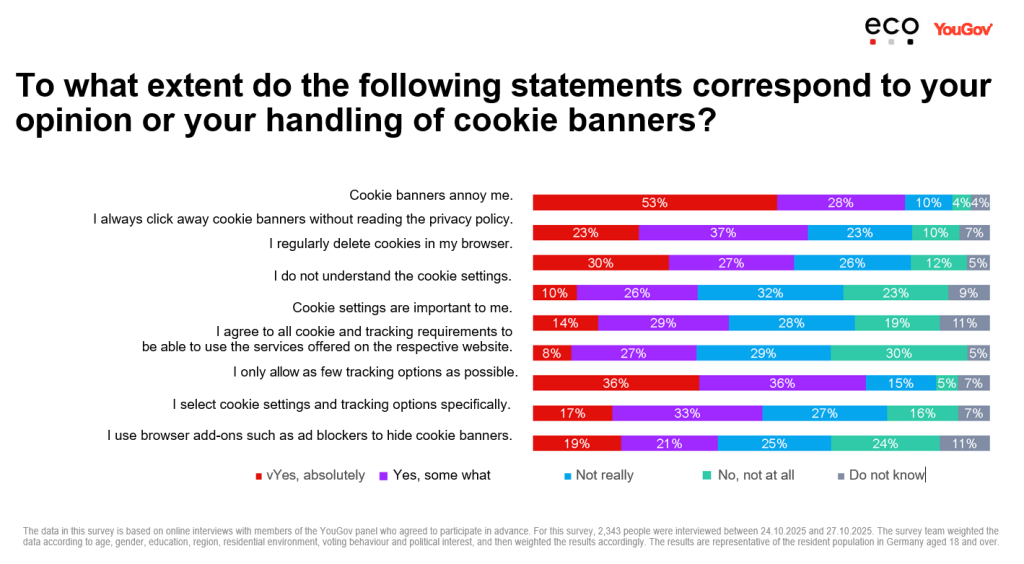
- YouGov survey: 82 per cent* of Germans are tired of cookie banners; only 14 per cent* are not annoyed
- 41 per cent* of respondents activate add-ons such as ad blockers to bypass cookies
- The eco Association calls for harmonisation and simplified rules against excessive cookie notices – the Digital Omnibus could be the first step.
Germans seem to agree on one thing when it comes to Cookie Day: the majority are annoyed by cookie banners online. While 82 per cent* of the population are tired of consent notices, only 14 per cent* do not find data protection notices annoying. This is the result of a representative YouGov survey commissioned by eco – Association of the Internet Industry**. Respondents rated the extent to which different statements about cookie banners correspond to their opinion or their handling of cookies.
Alexander Rabe, Managing Director of the eco Association, comments: “Cookie banners were originally established to provide greater data protection and control for Internet users. In fact, they mainly result in one thing: consent fatigue.” Thus, a well-intentioned concern – data protection on the World Wide Web – is rather undermined by overcomplication and excessive bureaucracy.
Implementation misses the mark on data and privacy protection
To avoid having to fill out the pop-up window every time they visit a new website, many Internet users resort to workarounds. According to the survey, 41 per cent* use add-ons such as ad blockers that suppress cookie requests. “Ad blockers may seem like a practical tool for reducing annoying notifications, but they also create disadvantages for both sides,” says Rabe. He explains: “For users, they mean, among other things, restricted access to content, less personalisation on the website and potentially less transparency in the selection of data protection options.” For website operators, such blockers could mean a loss of advertising revenue and distorted analysis data, which is particularly disadvantageous for digital service providers in the EU.
Cookie banners more of a hindrance than a help
Cookie notification windows are not only a real obstacle to user-friendliness, as users have to click on them repeatedly. According to the survey, 36 per cent* of respondents agree with the statement that they do not understand the content of cookie settings. Only 17 per cent consciously select tracking options. Alexander Rabe sees this as a problem and appeals, “The Internet must be accessible and understandable for all citizens.” The way cookie banners currently work and are handled conflicts with this goal.
eco Association calls for a more uniform and simpler data protection solution at EU level
Germans do care about data protection: 73 per cent* allow as few tracking options as possible, and over half (57 per cent*) say they regularly delete cookies. This means that the majority are fundamentally concerned about their own data protection. However, the survey also confirms that the existing rules are far from being implemented optimally.