- 82 per cent of respondents support age restrictions
- 54 per cent consider them impracticable
- eco – Association of the Internet Industry: Age limits only make sense with practical, Europe-wide uniform solutions
While politicians and the public at EU level and in Germany are discussing a possible age limit for social media, a recent survey commissioned by eco – Association of the Internet Industry shows that the majority of respondents are in favour of such a regulation in principle – but consider it hardly feasible.
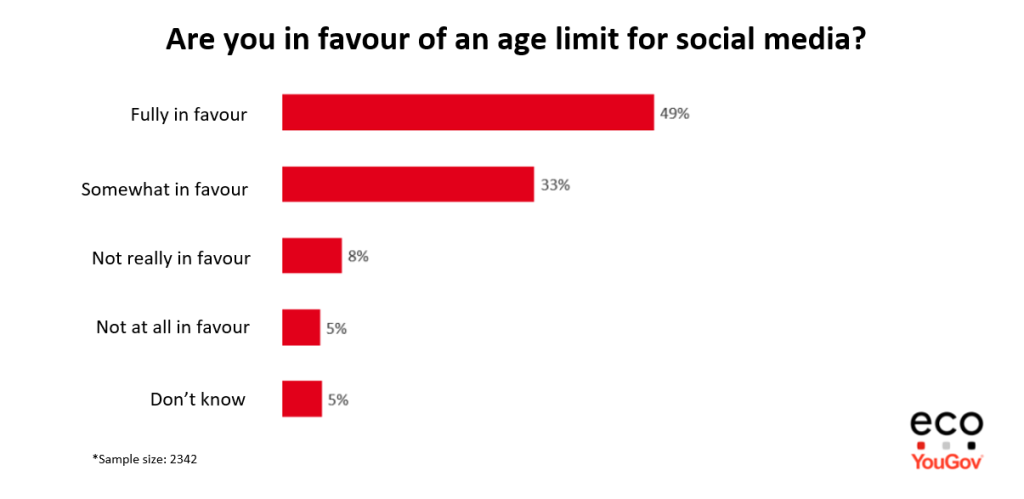
According to the survey, 82 per cent of respondents support an age limit for social media platforms. At the same time, more than half (54 per cent) believe that such a regulation would be impracticable in reality.

Respondents consider it important for parents to have a say in their children’s use of social media, depending on the child’s stage of development.
- 47 per cent would like parents to have to give their consent if children under the age of 16 want to create a social media account
- 46 per cent are in favour of app stores blocking downloads by under-13s without parental consent
- 40 per cent are in favour of a strict social media ban for children under the age of 13
- 34 per cent welcome a strict night-time ban for minors
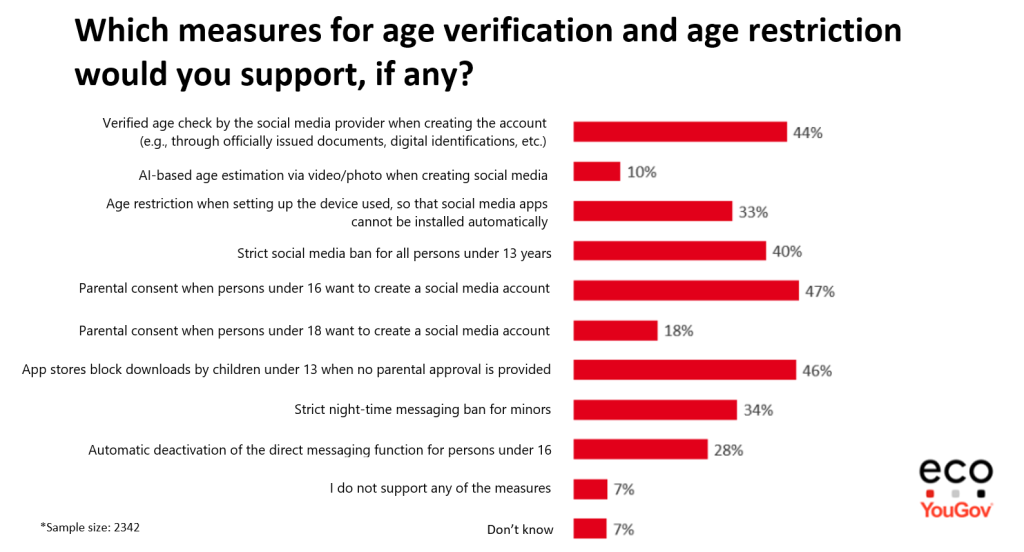
*Respondents were asked to select the measures they’d support for age verification.
With regard to the type of age verification, 44 per cent of respondents are in favour of verified age verification by social media providers, e.g. via digital identification. However, only 10 per cent would welcome AI-based age estimation via video or photo when creating a social media account.
eco warns against unilateral national measures
“The protection of minors in the digital space is an important concern – but it requires practical, data protection-compliant and, above all, Europe-wide coordinated solutions,” says Alexandra Koch-Skiba, Head of the eco Complaints Office.
“Currently, there are differing views among Member States on the subject of age restrictions for the use of social media by children and young people. If this were to lead to national isolated solutions, it would make the protection of minors more difficult rather than improving it. For internationally active platforms, a uniform European basis is crucial in order to be able to act effectively and with legal certainty.”
Koch-Skiba emphasises: “Overly strict age limits would counteract the idea of participation. Parents would rather have a say in order to be able to appropriately guide their children.”
eco considers practical age verification to be crucial
The current political discourse on the protection of children and young people when using certain online services attributes an increasingly important role to the age verification of users. For service providers, it’s essential that age verification is practicable and legally secure. In addition, data protection and user-friendliness should be kept in mind – for example, through “zero-knowledge” procedures that do not disclose any personal data.
“Data protection and user-friendliness require that age verification does not necessitate users to disclose their identity to the service provider. Even with extended verification requirements, anonymous Internet use must remain possible,” says Koch-Skiba. “In view of current political debates, we’re committed to an open, practical exchange of technical solutions for reliable and practicable approaches.”
The eco Association points out that many providers have already integrated a wide range of protective mechanisms for young people. Possible legal changes should build on this and support proven protective measures for the respective services, rather than counteracting them.
* The data in this survey is based on online interviews with members of the YouGov panel who agreed to participate in advance. For this survey, 2,343 people were interviewed between 24 and 27 October 2025. The survey was quota-adjusted according to age, gender, education, region, residential environment, voting behaviour and political interest, and the results were subsequently weighted accordingly. The results are representative of the resident population in Germany aged 18 and over.