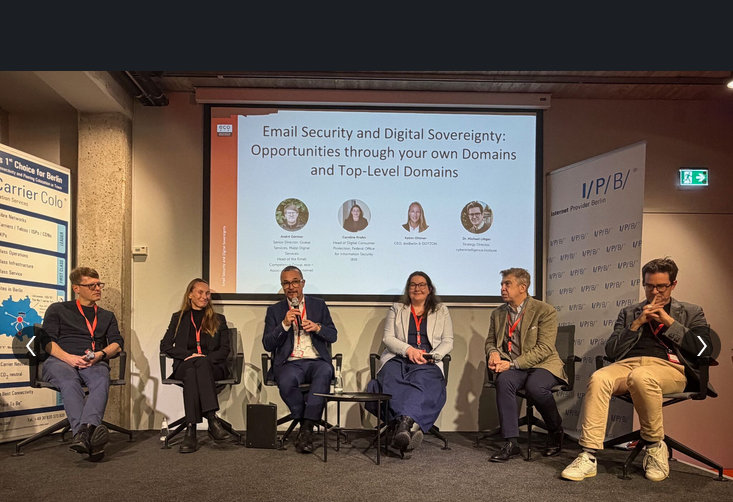
Leading experts from technology, business, and public policy convened in Berlin on 19 November 2025 to discuss how domain ownership and top-level domains (TLDs) can strengthen email security, digital sovereignty and trust in online communications. The panel discussion, hosted by ICANN and eco – Association of the Internet Industry at IPB Internet Provider, explored practical, economic and policy dimensions of digital independence in an increasingly complex geopolitical environment.
Moderated by Thomas Rickert, Director of the Names & Numbers Forum at eco, the discussion brought together speakers from across the digital ecosystem, including Dr. Michael Littger (cyberintelligence.institute), Katrin Ohlmer (DOTZON GmbH), André Görmer (eco Association), Caroline Krohn (German Federal Office for Information Security – BSI), and Christopher Mondini (ICANN).
Domains as a foundation of digital sovereignty
Panelists agreed that digital sovereignty is not only a political ambition but a technical and economic necessity. Control over domains enables organisations to maintain authority over their digital identity, reduce vendor lock-in and safeguard critical communications. Even simple ownership of second-level domains allows organisations and individuals to remain portable across service providers while preserving trust and continuity.
Dr. Michael Littger emphasised that sovereignty is closely tied to economic value creation, warning that Europe risks long-term dependency if core digital infrastructure and intellectual property remain under foreign control. He argued that reliance on external providers can become a systemic risk comparable to former energy dependencies.
As Thomas Rickert noted, domain ownership provides a concrete, achievable path toward sovereignty, security and resilience. Even simple second-level domain ownership provides vendor-agnostic identity and the freedom to change underlying platforms.
Strengthening email security through domain control
A central focus of the discussion was email security. André Görmer highlighted the shift from IP-based to domain-based authentication, stressing the importance of standards such as SPF, DKIM and DMARC. Properly managed domains and, where appropriate, proprietary or restricted TLDs enable organisations to significantly reduce phishing, improve deliverability and establish clear trust signals. Earlier this year, the German Federal Office for Information Security (BSI) and the eco Association sent a strong signal for secure digital communication with the “Email Security Year 2025” initiative.
Katrin Ohlmer illustrated these benefits with real-world examples, including BNP Paribas (.bnpparibas), which reduced phishing attacks through its proprietary TLD, and Schwarz Group (.schwarz), which streamlined internal IT access by using .schwarz exclusively for all internal systems. Geographic TLDs such as .berlin and .nrw have established trusted namespaces for public services while strengthening brand integrity through controlled namespaces.
Pragmatism, policy and global interdependence
From the BSI perspective, Caroline Krohn emphasised a pragmatic approach: sovereignty does not mean isolation, but maximising control through technical safeguards and contractual measures within a global ecosystem. Dependencies are unavoidable, she noted, but they must be transparent, managed and continually assessed.
Christopher Mondini underscored ICANN’s role as a neutral, multistakeholder steward of the DNS, enabling global cooperation even amid geopolitical tensions. ICANN’s limited technical mandate, he argued, is essential to preserving the stability and resilience of the Internet.
Key takeaways
The discussion concluded that domain ownership is one of the most concrete and achievable tools for improving digital sovereignty today. For businesses, policymakers and individuals alike, domains form a stable foundation for secure communication, trust and resilience – complementing emerging regulatory frameworks such as GDPR and the EU Data Act.
- The full summary is available for download as a PDF here.