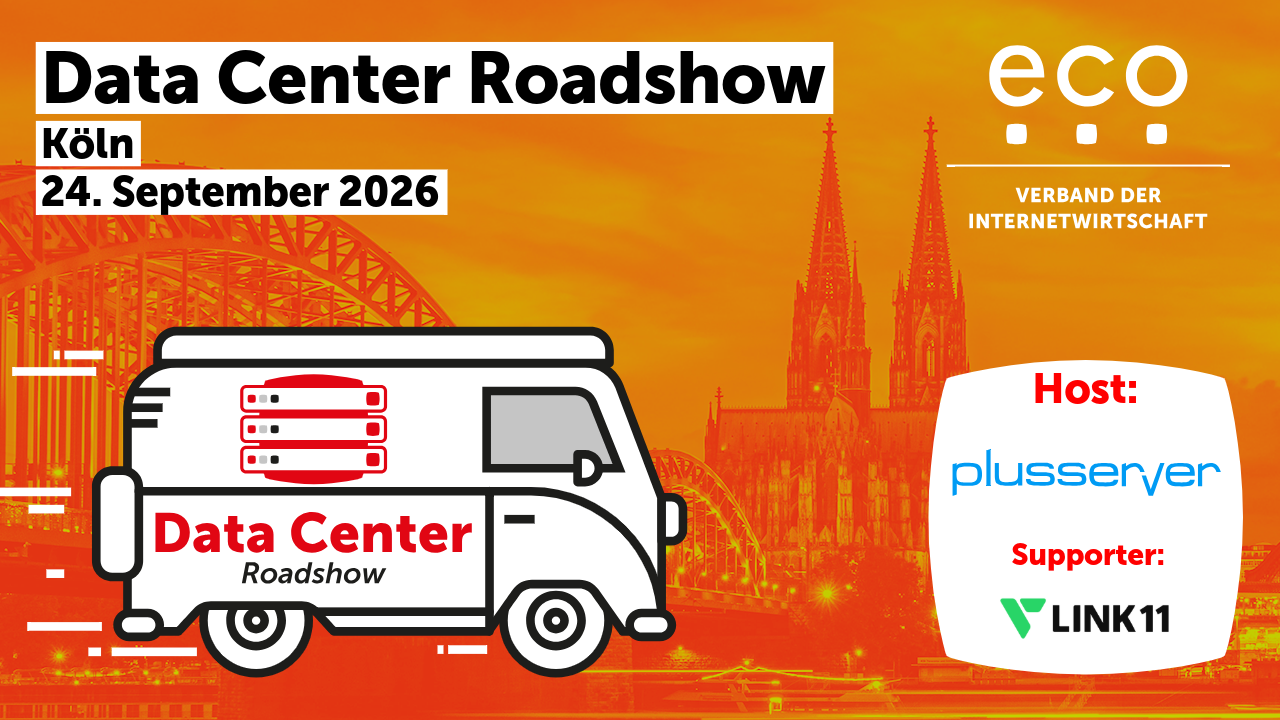
Today, companies need to assess their IT infrastructure from several perspectives. Cost-effectiveness, security and regulatory requirements are just as important as technological flexibility. At the same time, many companies lack the resources to operate complex platforms themselves on a long-term basis. In this interview, plusserver Chief Commercial Officer Peter Höhn explains the opportunities offered by open-source-based virtualisation and managed private clouds, and what companies should bear in mind when developing their infrastructure strategy. He will be on site as an expert at the launch of this year’s eco Data Centre Roadshow on 24 September 2026 in Cologne.
Many companies are currently fundamentally reassessing their existing virtualisation strategy. What has changed?
We are seeing that companies today are looking much more closely at the dependencies they create through their IT infrastructure, whether technological or economic. Particularly when it comes to business-critical applications, unexpected cost developments or severely limited choices simply pose a risk. This is why open technologies and alternative operating models are increasingly coming into focus. The crucial point, however, is that an alternative must function just as reliably in day-to-day business as the established solution.
What role can open-source-based managed private cloud approaches play here, and for which companies are they particularly interesting?
Primarily for companies that operate sensitive or business-critical workloads and want to retain control over their infrastructure. These may include ERP and CRM systems, databases or bespoke business applications that do not readily fit into a traditional public cloud. At the same time, many IT teams do not want to operate an entire virtualisation platform themselves and build up additional resources for this purpose. Managed models can combine dedicated infrastructure with an open technology stack while at the same time relieving companies of the burden of ongoing operations. One example is our Proxmox-based Managed Private Cloud, which follows precisely this approach.
Open source sounds like greater independence. For some IT managers, however, it also sounds like more work. How can this apparent contradiction be resolved?
That is precisely the key point for us: technological openness must not mean that companies are then left to deal with additional complexity on their own. A managed approach can cover operational tasks such as setup and monitoring, networking and updates, as well as lifecycle management and troubleshooting. Companies therefore benefit from an open-source-based virtualisation stack without having to turn it into a new internal infrastructure project. In our view, technological openness and managed services are not mutually exclusive; rather, they can complement each other effectively.
Alongside technological openness, costs also play a major role. What should companies consider when it comes to predictability?
Today, IT decision-makers not only need to provide high-performance infrastructures but must also be able to calculate their costs reliably. Clearly defined configurations and transparent cost models can help companies assess ongoing expenditure at an early stage. Factors such as data transfer should also be taken into account. This reduces unexpected costs when usage fluctuates and provides a reliable basis for budget planning. This predictability is particularly important for business applications that operate continuously.
What role can managed private clouds play in a long-term cloud strategy?
In our view, there is no single infrastructure that is equally suitable for every workload. Rather, companies need the flexibility to choose the appropriate operating model depending on the application, data and requirements. Open-source-based managed private clouds can therefore form a building block within an open cloud strategy and be combined with public cloud and other private cloud scenarios. We also see our Proxmox-based Managed Private Cloud in this way: as one possible building block within a hybrid or open cloud architecture. Ultimately, what matters is that companies can design their architecture according to their own requirements.